Friday, 1 February 2013

Hyde Park On Hudson (12A)

And so, following hot on the heels of President Lincoln, Franklin D Roosevelt is brought to life in Hyde Park On Hudson - or, King's Speech II: Driving Miss Daisy, if you will.

Billed as the previously untold story of FDR with his mistress/cousin (at least fifth, so that's OK), and culled from letters found after Daisy died, Hyde Park On Hudson is weirdly both more AND less than that.

Because, while the "love" story is there, lurking in the shadows like a fifth cousin no one is supposed to know gave the president a hand job in his car, we also have Bertie and Queenie visiting the presidential homestead ahead of the outbreak of World War II.

And this is where things get complicated.

First, let's look at the positives. The performances can't be faulted. Bill Murray is great as FDR - acting with his eyes and face, given the president was unable to walk following a bout of polio. Olivia Colman and Samuel West take their turn as the royal couple, and manage to step out of the hefty shadows cast by Helena Bonham Carter and Colin Firth in The King's Speech. Olivia Williams is good as Eleanor (the woman the president is supposed to be legally sleeping with), and Laura Linney is fine as Daisy, the other other other woman.

It just all feels muddled and a bit light-weight.

Given the story came about from Daisy's stash of love letters and diaries, it seems odd that we don't actually get a clear picture of who she is, or why she decided to stick around as one of FDR's harem. She's portrayed as being shy, socially awkward, a bit wet and unsure of her place in the entourage, and FDR is certainly not a man to issue gushing sentiments of love and desire, so already the relationship seems off kilter.

Equally, FDR isn't painted as a man who commands sexual attraction - especially as his mother seems to be doing the matchmaking.

The relationship seems to be one of convenience - as in, it's convenient for everyone else.

And all of this is played out over the weekend of the royal visit. And not just any visit. Bertie was charged with getting America on side as that Hitler chap set his sights on taking over Europe.

And this, for me, is the actual story here.

It's got a clearer identity, it's better portrayed, and garners better performances from those involved (Murray's late-night chat with West is a great moment).

Questions of how Daisy knew anything about any of these events, given she was either at home with aged aunt or mooning about in the woods at night, are best left unasked. Presumably writer Richard Nelson did some research away from Daisy's scribblings, but one is still left thinking the rows in the royal quarters are the figment of his imagination.

It's almost as if he purposefully took the Queen's character in the opposite direction from HBC's portrayal just for the sake of being different rather than any actual historical accuracy.

And as the film progresses, we still don't know what the story is here - a love story or a political drama? Neither gets enough clarity or weight, and so we are left looking at the scenery.

It's as if Mr Nelson figured we knew who these famous people were, so there was no need to flesh out their characters. A simple sketch was deemed sufficient.

He was wrong.

Like I said, you can't fault the actors - they've done a good job with what they were given. They just needed more.

And so do the audience.

Sunday, 27 January 2013

Movie 43 (15)

The definition of "comedy", for those of you who are unsure or unaware, is the following:
"Professional entertainment consisting of jokes and satirical sketches, intended to make an audience laugh; A movie, play or broadcast intended to make an audience laugh".

The word "intended" is key for the directors and producers of the "comedy" Movie 43 - because it could be argued in court, should you want to sue them under the Trades Description Act, that they had MEANT to make audiences laugh.

The fact they failed miserably is more down to incompetence than negligence.

You see, the idea should have been a simple one - take a collection of Hollywood's biggest and brightest (plus Johnny Knoxville, Gerard Butler and Seann William Scott), put them in a variety of sketches, link them with an amusing tale of teenage pranking and watch the money roll in.

They just forgot a few things.

The jokes.

Of course, you might find something that tickles you here. Enough areas of comedy are covered - paedophilic incest, pooping on your beloved, testicles hanging off Hugh Jackman's chin, it's all standard fare. It was frankly amazing that no one was laughing.

And it's not even that the subjects they go at are tasteless - that's kind of the point of the film. The crime here is that it's NOT FUNNY.

And it could be. In places. There are smatterings of good ideas strewn across the 90 minutes, just nothing to warrant making a whole movie.

And the "twist" at the end (oh yes, there's a twist) comes, literally, with a full fanfare, flags and a marching band. If you don't guess it the minute the young lad flips open the laptop, you've failed. You can never watch films again.

Mind you, after this you may not want to.


(Normally the trailer would go in here, but I can't do it to you)

You never go into a film looking to slag it off, whatever the reservations (and the trailer gives you many) you hope against hope there's something you can enjoy. A chuckle would do, you know, let's not be greedy.

Hollywood can continue thinking that young spotty herberts with camcorders is what's damaging box office receipts, but it's not.
It's allowing unmitigated garbage like this to actually make it into the world's cinemas.


Saturday, 26 January 2013

Lincoln (12A)

You just know this film is going to scoop the Best Film award at The Oscars.

Not because it's worth it - it's not. Argo, Zero Dark Thirty and Beasts Of The Southern Wild are all better films.

It'll win because it ticks all the boxes.

Faithful portrayal of a revered historic figure? Tick.

Stellar support cast, helping the leading man shine? Tick.

Mawkish orchestration? Tick.

Landmark moment in history? Tick. (Well, two ticks actually. Arguably three.)

Yup, all the little duckies are in a row.

That's not to say Lincoln is a bad film - it isn't. It's just not as great as it would have you believe. It's pedestrian in the extreme, it's over-long, more people make speeches than the man himself managed in his lifetime, and it's cloying sentimentality actually detracts from the good work Lincoln did - and that this film manages.

On the plus side, Daniel Day Lewis is outstanding, carrying himself with the tired grace of a man entering his second term with the pain of war still hanging around him like a shroud. He is stern when needed, impish when telling stories he knows both annoy and distract, aloof and distant when matters of state (and family) weigh heavy.

Sally Fields plays Mrs Lincoln like a woman thinking this could be her last throw of the Academy dice, slightly hammy and over the top, but still manages to convince as the power behind the White House Throne.

Elsewhere, Tommy Lee Jones is at his gruff, understated best as Thaddeus Stevens, James Spader is surprisingly joyous as Mr Bilbo, John Hawkes (off of The Sessions and Martha Marcy May Marlene) continues to show just how good an actor he is and David Strathairn is wonderfully cold as William Seward.

As for the subject matter, Steven Spielberg manages to have the conversation about slavery Quentin Tarantino thought he was having with Django Unchained - bringing to life the struggle to pass the 13th Amendment into law.

OK, it's still not a look at slavery from the point of view of the poor sod in the chains, but the passion of those trying to do the right thing, in the face of those who resented the thought that black people should be treated as equals, is well staged.

After that, it all starts to get a bit bogged-down in its own self-importance.

Obviously there were political machinations - Lincoln was trying to outlaw slavery while simultaneously ending the civil war. He was a busy guy.

It's just that there are moments when the whole thing feels like a Dickensian-themed episode of The West Wing with Forrest Gump's mum as the special guest.

It feels stretched, convoluted, as if Spielberg had decided how long the film was going to be and just kept adding bits when he fell short. ("Damn, need another five minutes.... who else can we have being persuaded to back the bill...?").

And it trots along like one of the Lincoln's slower carriages being pulled by a lame horse. There are moments when you are willing John Wilkes Booth to arrive ahead of time.

But he doesn't.

Finally, we get to the vote - which, given we know the outcome, is actually tense, sharp and well constructed and delivered.

And you think it's over.

I mean, what else is there to say and do? He's freed the slaves, got The South to surrender, there's nothing left. Cheers in the House, papers waved in air, applause and pats on back all round, Southern leaders looking like they've swallowed lemons - it's all good, no?

Not unless you're going to..... Oh Steven...

If I'd been on my own at home watching this, I would have spent the last 10 minutes shouting at the screen.

It's not just the fact Spielberg feels the need to see Lincoln through to the end, it's the manner in which he does it. Again, mawkish is the word. Poignancy played to the nth degree.

And there's no need.

There are some very good passages in this film, and as I've said you can't fault the performances, it just feels like Spielberg was trying a bit too hard.

Friday, 25 January 2013

Zero Dark Thirty (15)

A lot has been said and written about Zero Dark Thirty already - mainly that it is pro-torture.

Somehow, it seems, in making a film about the hunt for Bin Laden, director Kathryn Bigelow was supposed to either gloss over how the CIA went about its operations or make a judgement and show it all in a bad light.

It has also been suggested that the only reason we're talking about this is because both Zero Dark Thirty and its star, Jessica Chastain, are up for awards.

Whatever the motives behind the discussion, it's been easy to forget that in the midst of all the hubbub is a movie.

And what a movie.

Anyone who saw The Hurt Locker will already know that Bigelow knows her way around a military compound or two - and here again she excels herself.

Sure, we all know how this story plays out (if you don't, I can only assume you were in the back of the cave America was searching for...), but that in no way detracts from the emotional punch of this film.

This is no small part down to the excellent Chastain (she of The Help fame).

Through her portrayal of the driven CIA agent Maya, we are taken through the dead ends, the back streets and the explosions before being made to sit on the sidelines as the army go in.

By the end, I was sharing Maya's tears.

There is tension throughout this movie, there are moments where you jump in your seat as bombs go off, and during the raid on ol' BL's compound I was actually holding my breath.

You see, Bigelow's gift is how she tells the story.

Things start off slow, as we join the CIA in being all at sea in the search for the world's biggest Bogeyman. We are shown how the world got involved, how London tragically played its part in the play by being victim of the 7/7 attacks, how those at the top were so afraid of making the wrong call they almost preferred making no call at all.

And while all this is going on, you are just gripped in your seat, unable to take your eyes off the screen.

Chastain is simply mesmerising as the driven CIA agent who dedicates her professional life to hunting the man behind the 9/11 attacks, perfectly capturing the shift from uncomfortable newcomer to fiery ice maiden who keeps pushing until the job is done.

The supporting cast, meanwhile, is equally up to the task. There's no one being carried here. Every actor brings their A-game, every word uttered has a point and meaning. Nothing is there to be trimmed.

Writer Mark Boal also deserves all the plaudits and credits heading his way. By eschewing any backstory for any of the characters, we are left to focus purely on what is happening in the 'here and now' and what lies ahead. We don't need to know where Maya grew up, we don't need to know where she went to college. All necessary information is in the detail of the dialogue, you need nothing more.

A brief word, then about the torture. Sure everyone's talking about it, but given it takes up a sizeable chunk of the opening third of the film, it's hard not to.

There are no judgements to be made here. Bigelow simply says that it happened - which it did. To say otherwise would seriously dent the movie's credibility. Dan has been at it a while and is hardened to it, Maya hasn't and isn't.

What the film tells us is that torture changes people - on both sides of the bucket of water - without necessarily getting the required result.

The point is well made that information gained under duress can not be trusted, and that sometimes simply checking a folder more thoroughly can get the required result.

Looking back at Zero Dark Thirty, and trimming away all the white noise, what you have is a gripping thriller.

I wasn't a fan of the use of 'chapters' (captions telling us where we were in the story), as it seemed to lend the film an air of docu-drama that was both unwarranted and inaccurate - but that's a minor quibble.

It's funny, in a way, that this is a week where two of America's (and, by inference, the world's) landmark historic moments are played out on screen. One wonders what Lincoln would have said if he'd known where his fledgling nation was headed.

Put more simply, I've run out of superlatives.

Tuesday, 22 January 2013

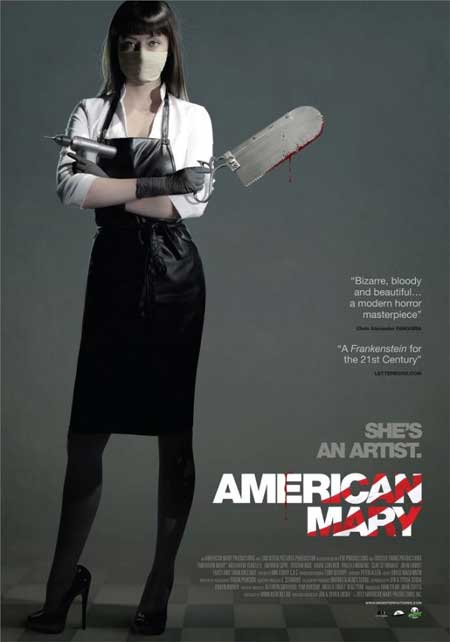
American Mary (18)

So what do you want from a good horror film?

Lots of screaming and running about?

Chainsaws/axes/cutty-up gloves?

Blood washing over the set in scarlet waves?

Well, jog on. This is not the film you are looking for.

However, if you want a psychologically-tense ride that will have you squirming in your seat, eyes glued to the screen despite half your brain screaming at you to look away, then this is the badger for you.

Although it probably started out as a moose before Mary got hold of it.

The story is a simple one. Mary (the amazing Katharine Isabelle - check out Ginger Snaps if you don't believe me) is a student surgeon whose finances are in need of a desperate life-saving procedure.

Her need to pay the phone bill - and rent, and then eat - leads her to apply for a job as a stripper. She leaves the interview, cash rich, having instead carried out some emergency work on a bloke strapped to a table.

I'm guessing the interview process is slightly less arduous at McDonald's.

One thing leads to another, and Mary is soon helping the somewhat disturbing Ruby achieve her dream of becoming a doll.

And she thought practicing on a turkey wouldn't come in handy, eh?

Having already crossed one line, she is then dragged across another having been drugged by a man she previously trusted.

And that's when her life really starts getting weird.

Isabelle is the absolute star of the film. Not just because she's the lead character, not just because she's in pretty much every scene, but because her performance is so mesmerising she draws you in from the moment she appears and holds you in her thrall throughout.

But let's not take anything away from the Soska sisters (who also make a delightfully twisted appearance).

Much has been said about how in American Mary they are turning the tables on the horror genre, making Mary the heroine rather than the victim. But their real skill is in how they make the audience wriggle and squeal.

It would be easy in a film that centres around the body modification business to go big on the surgery. Scene after scene of limbs being cut up, tongues being split and the red stuff spurting would have been an obvious choice.

Instead, Ms Soska and Soska (aka the Twisted Twins) take great delight in what they don't show you. They draw you in, and at the last minute let your imagination do the rest.

And that really hurts.

Yes, there's the odd quibble here and there (the surgeon suddenly being dumped in Mary's apartment happens with so little fanfair as to be almost puzzling), but it doesn't detract from what is a wonderfully gripping, compelling, twisted, squirm-inducing delight.

(After the briefest of runs at the cinema, American Mary is now out on DVD)

Sunday, 20 January 2013

The Sessions (15)

Sometimes a film ambles along that, while you know what it's about and you feel prepared for what's to come, completely sideswipes you.

The Disappearance Of Alice Creed was one. Tyrannosaur another. 127 Hours and Black Swan two more.

Now, granted, The Sessions can't be compared with any of those in terms of genre, but the emotional punch and after-effects have been similar.

And not just 'cos I'm British and we don't talk about these things...

For those who've missed the gist, a brief summary: Boy can't meet right girl and do boy-girl things as boy lives most of his life in an iron lung. Girl, meanwhile, specialises in helping people overcome bedroom issues by, you know, doing it. With them.

You wouldn't get that on the NHS. Not without a major court case.

In simpler terms, this is the true story of polio victim Mark O'Brien (played brilliantly by John Hawkes) who is unable to move from the neck down and lives in a metal tube when he isn't being wheeled around San Francisco by one of his helpers.

Still a virgin at 37, and having been asked to write a piece on sex and disability just after having his heart broken, he starts to wonder if he'll ever know a woman "in the biblical sense".

Fate takes an interest, one thing leads to another, and before you say 'she'll have to go on top, obviously', he's meeting with sex therapist, Cheryl  (Helen Hunt).

Based on the article he wrote about his experience, and told in part through confessions with Mark's priest (the wonderfully craggy William H Macy), we join Mark as he confronts his fears, his past and his future.

Now, if history has taught us anything, it's that Hollywood has a gift for making this kind of tale a saccharine mush-fest, glossing over any real emotional weight and just going straight for the sick bag.
Not here.

Heartstrings are tugged honestly, laughter is felt naturally. But there is no encouragement towards pity in what is a portrayal of the positive side of Mark's life - his quick, self-deprecating wit, his love of poetry, his ability to charm people.

Through Hawkes' marvellous performance we see Mark's transition from frustrated, almost school-boy innocence to a man who has experienced physical fulfilment.

But the film isn't solely about Mark's drive to join the massed ranks of other men his age.
This is also about Cheryl.

In lesser hands, this could have been a cumbersome role - but Hunt brings a subtlety and sensitivity to play that is tender and emotive, capturing perfectly the conflicting emotions that come in to force as the sessions progress.

And this isn't a two-horse race, either.

With two such strong lead performances, it would be easy to forget there are others who have something to add to the story - other people key to Mark's thoughts and feelings.

Along with a superbly-balanced supporting cast, the other star of the show is Macy, stumbling and mumbling along as Father Brendan - a man who seems to be struggling as much with his own faith as he is with what to say to a man on a gurney who wants to get laid.

This is a film that tackles a delicate subject (the sexual desires of those not always physically able to satisfy them) in a grown-up way, making us laugh as well as think.

I'd like to say more about the film, but I can't for fear of ruining the ending - suffice to say, I had something in my eye on a few occasions. Erm...


Friday, 18 January 2013

Django Unchained (18)

There aren't many directors in the modern era who can generate a buzz about a new film in the way Tarantino can.

Before so much as a frame has been seen, the sense of anticipation starts to build, and then the trailer arrives and the world goes nuts.

He's made some duffers over the years, sure, but his reputation as the film geek's geek is unsurpassed. He may not know how to keep a film short, but he knows all the genre conventions and styles for the story he wants to tell.

And so it is with Django Unchained.

Billed by the man himself as a film about slavery (more of which later), Django Unchained is an open love letter to the Westerns of old, in particular the work of Sam Peckinpah. And, strangely, Mel Brooks.

There's also the odd nod or two to  Tarantino's first love - 70s martial arts movies. Sometimes the boy just can't help himself.

The first hour of this film is a joyous, death-filled romp through the Deep South. Christoph Waltz steals every scene he's in as Schultz, the dentist-turned bounty hunter with a love of admin. From the moment he arrives on his little wagon, you find yourself grinning. He's clearly having a blast with this character, and it spills off the screen in highly infectious waves.

Jamie Foxx, meanwhile, is the epitome of cool as Django. He's got the swagger and style of a younger Samuel L Jackson (who himself turns in a stellar performance as the loathsome Stephen later on), and develops brooding menace as Waltz teaches him how to bring in the bad guys.

Even Don Johnson's brief appearance as a plantation owner isn't terrible. It's all going swimmingly, in fact. Guns go bang, corpses stack up and the red stuff flies around with all the heft of a disgruntled worker in a Dulux factory.

And then something happens.

It's not a bad something, don't get me wrong, but there's a clear tonal shift that is so marked it almost makes the large chunk of movie featuring Leonardo Di Caprio's Southern Gentleman Monsieur Candie seem like a different movie.

From the violent bounce and oomph of our heroes trekking across Texas, we're suddenly in a dark, menacing, almost Gothic version of Gone With The Wind.

Like I said, it's not a bad thing. Jackson and Di Caprio (not forgetting the wonderful Kerry Washington as Django's long-lost wife) are excellent, and the sense of fear that runs through the house and staff is palpable.

It just feels like a different movie.

Fortunately, by the final reel (do they actually have reels anymore?), the body count is back on the rise and the house looks like DIY SOS went postal with a paint gun.

And if the final shoot out and Django's final acts of vengeance don't have you laughing out loud, there's something wrong with you.

I just have one slight reservation (and is isn't the running time - this film may be 15mins shy of three hours, but it still felt shorter than the Hobbit), and that's the conversation Tarantino keeps saying we need to have about slavery.

He's insistent on this. This is a film about slavery, no one's talking about slavery any more, slavery, slavery, slavery. It's pretty much all he's talked about in all of the interviews I've seen or read.

But it's not a film about slavery. It's a love story. Yes Django and Broomhilda are slaves, but this film no more tackles the issues of slavery than David Cameron cares about poor people.

To have a discussion about slavery, this film needs to show us things that we don't know about, things the history books don't tell us. But it doesn't.

What we learn about slavery is that it's abhorrent, dehumanising, the effect of one race's happiness in oppressing another. None of this is news.

Now, a cynic might observe that Django Unchained is up for a couple of Oscars. A cynic might also observe that Lincoln (a film not without its own angle on the slavery story) is also up for a few Oscars.

That same cynic might possibly conclude that the whole slavery sales pitch was added long after this film was written, and that the great Harvey Weinstein (producer of this particular little ol' movie and a man with a track record of bringing home the awards bacon) saw an opportunity...
Far be it from me to think that, of course.

All postulating aside, however, Django Unchained is a quality addition to the Western genre. It wears its heart on its blood-soaked sleeve. The gun fights are gloriously overblown. And the scenery is at times stunning.

Just let the film speak for itself.